Anchor Rock

TaoCraft Short Sip is Tarot for your day in the time it takes to sip from your coffee. Want a whole cuppa Tarot all your own? Private readings with the blog author are available by email and can be ordered 24/7 no appointment needed

Welcome to the blog and podcast. I’m glad you are here. TaoCraft Short Sip is Tarot contemplation in the time it takes to sip from your coffee. If you are enjoying these blog posts and podcast episodes, I hope you will visit the TaoCraft Tarot page on K0-fi and consider becoming a patron of the Tarot arts. The link is in the episode description for podcast listeners. Proceeds from the ko-fi shop and memberships all support the creation of posts and episodes like this one. Thank you so much for your support. Your likes, subs, follows, shares, questions and comments are always, always, always welcome and appreciated!

Let’s start today with one of my favorite ideas on the planet: wabi sabi.

No, it isn’t that green paste that comes with sushi, although I like THAT a lot too.

As I understand it, wabi sabi is a philosophy and an aesthetic that values things as they are and sees beauty in natural, spontaneous imperfections and asymmetries. Old but valued ceramics are preserved and repaired with great care, sometimes highlighting the repairs with precious metals. I’m no expert. I’m not even average-level knowledgeable about Japanese or Chinese thought or culture. All I know is that everything I’ve ever learned about Taoism, Zen and wabi sabi has helped me to live a better life and be a better person. For that, I am deeply grateful. These ideas have time and time and time again proven to be my unshakable rock in every storm, just like the rock and anchor on today’s card, the Hope card from the Alleyman’s Tarot deck.

Speaking of spontaneous imperfections, the card is mislabeled in the video. The intuitive message from the card was, however, clear, concise and clairaudient (meaning the intuition came as mental words this time instead of the usual clairvoyant mental images.) It came in two parts.

First, “Storms will always come.”

The first noble truth of Buddhism is the truth of suffering. First on the list of world religions on that old 80’s T shirt is Taoism with the assertion that “shit happens.” Things break. Things are uneven. Stuff happens and sooner or later storms always come.

And it’s beautiful, because it is alive and it is real.

L’esperance, as the card is actually named, is a French word meaning hope. Storms will come. Sometimes the only hope is to find a rock and hang on.

The second half of the clairaudient message is “Know your rock.”

A paramedic instructor once told me that if you prepare for the emergency, then the emergency goes away. The same thing applies here. Knowing which ideas and philosophies you can trust makes life’s inevitable stress just that much less intimidating. Question everything. When it comes to beliefs or dogma or other peoples unsupported assertions, questioning is invaluable. It may take a trial by skeptical fire to find out what really is your philosophical storm shelter. If you know your rock, if you know where to find your anchor when the storm comes then you just might make it through to the other side intact enough to glue things back together and paint the cracks with gold.

I’m not here to tell you what your rock or your anchor is or should be. It is difficult, if not impossible for one person to determine that for another. The things I was taught as a child should be my strength and stronghold crumbled to dust and nothing at first contact with adulthood. I’ve since learned that it is much better to scout out the territory for yourself. Trust yourself to know what gives you hope. Trust yourself to lean on ideas and know what holds you up and what doesn’t. Explore new ideas and challenge old ones. Give them all a good hard kick and see if they hold strong for you. If they do, grab on because storms will always come and it pays to know your rock.

Thank you so much for listening. See you at the next sip.

L’Esperence (Hope) image from the Fancy Minchiate Tarot, cited copyright “BnF” This card from the Alleyman’s Tarot deck by Publishing Goblin LLC, used with permission.

TBT: Ogres and Onions

Throwback Thursday to ogres, onions, and peeling back the layers of the TaoCraft Tarot reading layout (available by email, no appointment needed)

Shrek: ….ogres are like onions

Donkey: They stink?

….

Shrek: No! Layers. Onions have layers. Ogres have layers. You get it? We both have layers

from “Shrek” copyright 2001 Dreamworks Pictures, quote via imdb.com

Layers mean complexity. Layers apply to all sorts of things that are actually more complex than they seem at first glance; ogres, onions, cakes and – you guessed it – Tarot.

Reading Tarot for yourself is actually quite simple. In a couple of hours I could teach you to do good DIY readings for yourself. (Related: PeaceTarot ebook)

Reading for other people is another story. High level professional readings are, like onions and ogres, more complex than it seems on the surface. That’s the whole point of them. A professional reading can gives you extra layers of insight and experience that you can’t get alone. Two heads are better than one. Two eyes give depth perception (related post: parallax) The two of us working together gives your reading another layer of understanding.

Sometimes layers talk about authenticity. Sometimes you have to peel back a few layers to get to the real heart of the matter. We’ve talked about authenticity and public Tarot practice before, after my Modern Oracle Tarot work was re-branded to TaoCraft Tarot (related: what’s in a name, Shakespear’s Roses, Spell Your Name)

That’s all well and good, but consider another aspect of layers: growing new ones. Interestingly, actual onions grow on the inside. New layers are added at the core while older outside layers get dry and thin and ultimately fall away. In this, onions give us another useful metaphor.

In the medical field, and no doubt many other professions, continuing education is a condition of licensure and employment. You have to keep learning and keep current if you want to keep working. Whether it is required or not, whether it is career related or not, lifelong learning is a respected mark of excellence. Learning isn’t just formal education. Learning comes from experience and experimentation and the living of life. Artists’ work evolves over time. Any person’s point of view can evolve over time.

And so, the “Modern Oracle” layout is evolving. I’m calling abort on the video / text hybrid format. It was an experiment that failed, and I’ve learned something important from it.

Remember how deeper layers are often perceived as more authentic and how old layers of growing onions turn papery and fall off? It’s time for the 5 and 7 card Modern Oracle layouts to evolve, to become more authentic, to show more of their inner complexity. The video hybrid isn’t the way for that to happen. The names of layout card positions are changing. It’s a tiny detail that you may not even notice from your side of the Tarot table. On my side of the table it is important shift in mindset. This allows me to fully and authentically follow what intuition and spirit shows me.

I wrote the initial layout meanings to create a bridge from old fashioned, predict-the-future, fortune telling layouts to a more modern advice, guidance and empowerment reading. I wrote the Modern Oracle layouts specifically to show the power of your choices over your future. Cards that once were called “past, present and future” in the old style became “lessons from the past, current situation, and moving forward.” Predicting the future evolved into making an action plan.

Now it will go one step further. I in my minds’s eye, I see a reading in terms of dynamic energy flows, not a concrete road through time. As Modern Oracle layouts become TaoCraft layouts, we will let go of time and predictions entirely. If the Modern Oracle layout was like GPS map for your path ahead, the TaoCraft layout is like a GPS traffic update with a weather report.

Card 1, lessons from the past, will become Fading Energies, symbolizing energies that are moving away from you. These are things that need less of your attention.

Card 2, current situation, will become Current Energies, the energies that are strongest, and deal with things that need your attention in this moment.

Card 3, moving forward will become Growing Energies, energies moving toward you, or gaining influence in the path you’ve currently chosen. It still isn’t predictive. It is still intended to guide you, help you prepare for possible conditions ahead. Think of it like a weather report. It doesn’t tell you exactly what will happen to you during your day, but it can give you the chance of rain or sun while it happens.

Card 4 will remain Choices. It is still placed under the current energies card and at the center of the layout because that is still the place of power. Empowering your choices is still the heart of the reading. The choices card will take on a more advisory tone than before. Instead of suggesting how to persist or how change your path, it focuses on whether changing or whether staying the course is the wisest thing to do.

Card 5 is still Alternative Path just like before, showing the most open alternative path you if you decide a change is needed. (Or it can help keep you on your path if you like the way things are headed.)

Card 6 Helping Energies and card 7 Potential Challenges are the same as always, and speak to exactly what the name implies.

Long story short, if you are dead set on a specific “accurate” prediction, you aren’t going to like the new TaoCraft layouts. If that’s the case, you need the Zombie Cat yes/no readings like we did the other day. Even then, you have to realize it isn’t 100%.

If you are ready for next level, dynamic energy readings, I can help. Welcome to TaoCraft Tarot.

Ride the Upside Down

TaoCraft Short Sip is Tarot for your day in the time it takes to sip from your coffee. Today: the King of Swords teaches us to surf the upside down.

Welcome to TaoCraft Tarot blog and podcast. I’m glad you are here.

Today’s card is the King of Swords, in reverse.

This big, slide prone Alleyman’s Tarot deck seems to like reversals. They feel the same and have the same message energy as reversals with other decks, despite being more frequent. That being said, the reversals with this deck seem to still be significant, despite being more frequent. So far, I haven’t gotten any of those “meh, it’s random, just turn it over and go on moments” like we’ve talked about before when it comes to reversals. This feels like turbulent energy more than an outright blockage.

Swords are air and intellect. Kings are leaders. They are in charge. Put those two together and you get a dispassionate, cool headed energy. In his interpretation of the card for the Alleyman’s Deck, Seven Asmund points out a sense of orderliness about the card.

Some people blame it on our view of Mercury in the sky. Some people blame it on a full moon. Hard data debunks any correlation between moon phase and human behavior, but my days working inpatient psychiatry begs to differ. Whatever the cause or irrational correlation, we are nevertheless left with the reality that life is messy. Things get irrational, chaotic, problematic, and way out of our control sometimes.

To quote the essence of Taoism according to the 1980’s T-shirt about world religions: shh -stuff happens.

I keep getting mental images of a knight in armour or the king of swords on a surfboard. Surfing is an apt analogy for today’s card. You can’t control the ocean. You can line up and order every wave that comes to shore.

If the king of swords in reverse hints at chaos, you can surf the wild changes. Chaos may reign, disorder may abound, everything may be outside of your control, but you are still in perfect control of you and your response to the upside-down-ness of it all. If you can’t control the wave, surf it in to shore. If you can’t turn things right side up, ride the upside down until it turns on its own.

Thank you so much for reading and listening. Your likes, subs, shares, virtual coffees, questions and comments are always, always, always appreciated.

Neither the blog nor the podcast are monetized and depend on your support. If you enjoy these blogcasts, please visit the ko-fi page (link below or in the episode description. Proceeds from there contribute toward creating the free to access Tarot content here.

I need to do a little real life upside down surfing myself, so short sip will return on Friday. Have a great week everyone!

I’ll be over here in the present moment for a few days.

Yesterday afternoon was weird.

The off-line real world was demanding attention like the “ease off the woo woo post” from yesterday morning – on steroids.

It’s going to be a busy long weekend. Some really great stuff, some pain in the tuchus stuff.

Email Tarot is still wide open though. Order all you want. This is the part the ducks were talking about where delivery times will slow way down for a few days. Fulfillment for any readings ordered now through Sunday.

In-person readings are open but scheduling and email replies are going to be slow, too. No in-person appointments are available until week of May 23 anyway. If you don’t want to wait for in-person, even without this weekend, email is a TON faster, gives you the same information and has more layout options.

The weekend Tarot Turnover intuition exercise for Tarot Table members will be delayed a day until Monday.

We’ve had several covid call offs at the day job, so I’m honestly not sure when the next short sip will be.

So please sit tight…I’ll be over here in the present moment for a few days. Keep cyberspace warm for me, ok? See you then!

Ease up on the woo woo

TaoCraft Short Sip is Tarot in the time it takes to sip from your coffee. Today, quotes about Alan Watt’s potatoes and Mark Salzman’s donkey.

Welcome to the TaoCraft Tarot blog and podcast. I’m glad you are here.

Today’s card is the eight of pentacles.

The pentacles are always grounded, practical cards and today is no exception.

The interesting thing about today’s card is it is reverse engineered. I don’t know about you, but the phrase “reverse engineered” always makes me think of science fiction, alien technology, conspiracy theories and that time people were Naruto running around area 51.

Maybe retrofit would be a better word. If you are interested in elevating your intuitive connection to Tarot, one good way to do that is to come up with an idea and then see what cards come to mind that represent the idea rather than choosing a card at random and letting that prompt the idea. You retrofit the idea to the card instead of the other way around.

Today, the energy around here is decidedly NOT spiritual or woo woo. Which is fine. It is a western, puritanical notion to think that we must constantly strive and work for spirituality and personal improvement. Sometimes the best thing do is do what needs done without all the woo woo or striving or self-judging. Sometimes you just have to sit on your workbench and hammer the dents out of your pentacles before moving on. Today’s energy pointed to the Eight of Pentacles instead of the card pointing out the energy.

Think for a moment about Mark Salzman’s donkey and Alan Watt’s potatoes.

As I’ve said a hoo-zillion times, this is just like when Alan Watts said that “Zen does not confuse spirituality with thinking about god while you peel the potatoes. Zen spirituality is to just peel the potatoes.”

In Taoism it IS personal growth and spirituality to live in harmony with nature. In this case nature means your feelings and energies for the day as much as the rocks and trees kind of nature.

Mark Salzmen, author and martial artist, once recounted the Chinese proverb that “it is the height of stupidity to go searching for the donkey you are already riding upon.

In Wicca for the Solitary Practitioner, author Scott Cunningham has said “the feeling is the power.” So if you are feeling pulled to the mystical or spiritual side of life today, by all means follow that feeling. If you are feeling like having a sammich and streaming your favorite movie, that’s an ok feeling to follow too.

It’s the trend line, not the individual day or data point.

All of those things point to letting the woo woo rest for a bit, and LIVE the things you’ve already learned. Do the things you already know to do. How is state of constant striving any better than not striving at all? Show yourself a little self love by accepting who you are right now and just go about your day with no pressure on yourself for a change. Immerse yourself in the day, and do the do. Do the do regardless of how stressed or how ordinary it all is at the moment.

Stop looking so hard and vibe with your donkey while peeling today’s potatoes. Live what you know for a while before striving to learn more.

Thank you so much for reading and listening.

I always appreciate any likes, subs, shares, follows, questions or comments that you can spare.

Proceeds from private reading sales and from the ko-fi page all contribute toward creating this free to access blog and podcast.

See you at the next sip!

Dance

TaoCraft Short Sip is Tarot contemplation for your day in the time it takes to sip from your coffee

Welcome to TaoCraft Tarot blog and podcast. I’m glad you are here.

Today’s card is “The Performer” from the Alleyman’s Tarot by Publishing Goblin LLC used with permission.

This is one of the cards I’ve never seen before, and just like always I try to read it before going to the deck’s guide book. When I haven’t seen or read the card before, I approach it just like reading a pip card like we talked about with the two of disks recently. Going into this card cold is the best of both worlds. There is a picture with lots of intuitive prompts, but no preconceived theme to box in the interpretation.

Too bad I got nothin’.

My first thought was “violin guy” and that was about it.

With a little more staring and contemplation, something I’d read finally came to mind from my old natural health reading. I can’t for the life of me remember much less cite the source, but I once read that it was a common thing for indigenous healers to ask when the patient stopped dancing.

It times the illness. It gives insight into the illness through the lens of mind-body connection. Western medicine (however begrudgingly) acknowledges that perceived mental stress can affect physical health. They also admit the benefits of exercise and activity. The mind-body connection flows in both directions. Poor physical habits and lifestyle can have a negative impact on mood just as much as stress can worsen disease. The converse is true. Healthy interventions on either side of the mind-body equation can benefit the other side of the equation.

Dancing is more than just physical activity. It is art and self expression and one of the most joyful things a human can do. I remember seeing interviews with Desmond Tutu when Apartheid ended in South Africa. He said he must dance with the rest of his people in his joy. Recently, on social media, I saw a post about the oppression of Native American culture in the past and how the person in the video dances now for all those who could not before.

No performance, no dance is empty unless we make it so. Even if we dance alone, we dance with our own humanity. Don’t stop dancing.

Thank you so much for reading and listening! I appreciate your time and attention. Any likes, subs, shares, follows, questions or comments you can spare are greatly appreciated too.

The blog and podcast are not monetized in any way and depend on audience support. All private readings ordered on the blog website, memberships, and proceeds from the TaoCraft Tarot page on ko-fi all help me to create and produce these free to access Tarot readings for everyone.

Thank you again. See you at the next sip!

Silence

TaoCraft Short Sip is Tarot for your day in the time it takes to sip from your coffee. Today: add power to your words with the power of silence.

Welcome to TaoCraft Tarot blog and podcast. I’m glad you are here

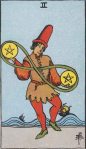
Today’s card is the two of disks from the Alleyman’s Tarot originally from the Serravale-Sesia Tarot.

This is a presumably public domain card from 1880s Italy. It is an interesting contrast to the better known Waite Smith Tarot and shows the difference in working with a deck that has only pips and a deck with complex narrative images on the numbered minor arcana cards.

Image cards and pip cards function the same way within a reading. Both are two paths to the exact same destination. They both take us to the message for everyone’s day, for our client or for ourselves. The emphasis shifts a little bit between the two types of cards, however.

With images, as we see in the RWS cards, there is a rich supply of detail to prompt your intuition. Despite the many prompts, all of them are thematically tied to the overall image and card meaning. Picture cards can lend themselves to a little more specificity, clarity and context.

On the other hand, pip cards give your intuition free reign. Pip cards are not bound by details or images, although they retain the same general conceptual meaning as an image card. This two of disks talks about balance much the same as the RWS two of pentacles .

Coins, pentacles or disks all refer to the same suit of the deck and you will see the terms used interchangeably. I tend to say coins because that was the name used in one of my first decks and it’s an old habit by this point. Coins are associated with the element of earth and ideas about work, career and money. From a more contemporary perspective it helps to think of coins as our relationship with the physical world. The suit has a very practical down-to-earth vibe generally speaking, so it all fits.

More than the number two cards of the other suits, the two of coins symbolizes balance. Usually it’s a very dynamic balance, like a unicycle rider who constantly makes small corrections and movements in order to balance upright. The taijitu, the yin yang symbol, is another example. The black and white parts of the circle are comma shaped instead of q straight line half to show motion and a dynamic interplay of opposites.

Today, the balance is more akin to the unicycle example. The message has a subtle, nuanced quality to it. It isn’t black and white. It is dynamic and speaks to the way we move through life.

In a way, it is just how human brains are wired and how our brains deal with the onslaught of sensory input from our environment. You get used to things, and they don’t get the attention commanded when something is new or changes. It’s like a busy caretaker tuning out a chattering preschooler a little bit. The message for all of us adults is the same. If you want to be heard, if you want your words to carry power and command attention, use them sparingly. As Mahatma Ghandi said “speak only when it improves upon the silence.”

Outside of a Medieval monastery, it is hard to go through life not saying anything. Communication is essential. In our wired, cyberspace connected world, we often forget the necessity of silence. When TMI takes we are immersed in too much information the tune-out-the-toddler reflex kicks in. We become numb to the input.

It’s a balance between communication, self expression, and losing your words to the noise. Nothing makes your words more powerful than the silent spaces in between.

Thank you so much for reading and listening.

The blog and podcast are not monetized and rely on audience support. Please visit the TaoCraft Tarot page on ko-fi and consider becoming a Patron of the Tarot Arts. The proceeds from ko-fi and private readings through the blog website all contribute to the creation of this free to access Tarot content.

See you at the next sip!

May the 4th be with you – because the force already is

no need to wish that the force be with you – because it already is.

Reiki has crossed my path lately.

That’s not entirely accurate. Reiki IS my path. Or at least a good chunk of it. Or one thread of the braid of it. It’s hard to describe. So let’s back up a few years.

I’ve been told that it is good to re-introduce yourself every now and then. Let me reintroduce you to the Reiki side of Tao Craft.

You know the Tarot part well, even if you have been following along just a short time. Ebooks and mala style meditation beads part of things are pretty self-explanatory for sale ko-fi shop and Etsy shop respectively.

It may seem a little odd to have Tarot and Reiki living in the same cyber space. Reiki and Tarot are actually connected at a fundamental level. The Venn diagrams of Reiki, Tarot and magick overlap so much as to practically be a circle.

It might not make sense at first glance. I mean, sure, Tarot is so associated with all the various forms of magick and witches that it is pretty much assumed that if you read Tarot you are a witch and vice versa. But Reiki? What does Buddhism influenced love, light, and lotus flowers have to do with Tarot and magick craft?

As the name TaoCraft implies, it has a lot to do with it. Whether you use eastern or western terminology, Taoism and Tarot, Magick and Reiki all spring from the same basic substrate of universal energies.

As a quick explanation in terminology, Reiki specifically means a method of energy wellness developed in the 1920s by Micheo Usui of Japan. Other methods of energy healing have come to be called Reiki just like the brand name band-aid has come to be used interchangeably with any adhesive bandage. Some newer energy systems identify as being derived from Usui’s work and so identify as a type of Reiki like (if memory serves) Karuna Reiki and the like. Other energy styles and systems may have started with Reiki but split off to differentiate themselves entirely from the traditional Usui system and take on wholly different names. That can happen on an individual or organizational level and doesn’t imply that the system is any better or worse than Reiki, just that it is a different thing all together. In addition to that you have other energy systems that have always been separate and distinct from Reiki since their inception. As I understand it, Johrei is a similar but religious Japanese discipline that grew in parallel to Reiki during the 20th century.

To be clear, whenever I say Reiki (pronounced “ray key”) I specifically mean the Usui system. I use “energy healing” or “energy wellness” as an umbrella term for all similar healing and wellness practices.

My training and certification is in the Traditional Usui style. I studied first and second level training with Karon Mellon of Sewickley PA in the mid 1990s then repeated these levels and progressed to the master-practitioner level under Master Thom Beardshall of McMurray Pennsylvania in 2000.

I don’t feel particularly drawn to teaching Reiki outside of writing about it. I’m a practitioner and, like Tarot, my strong suit is distance work. For the past four years since the TaoCraft Tarot rebranding, I’ve been focusing on distance Reiki and developing what I call “Sending Stones” distance Reiki sessions. I do call it Reiki because it is a Usui method distance session in accordance with my training BUT with the added embellishment of holding a selected stone or crystal to enhance the ambiance and enjoyment of the session. This is no different than the way many Usui practitioners embellish in-person sessions with music, incense, candles or aromatherapy.

There is so much more to say about Reiki. Far more than any one blog post can cover. So I’ll give you a little homework instead.

To see what the Reiki part of TaoCraft looks like, just click the Reiki tab at the top of the page on the blog, or in the menu if you are viewing the website on a mobile device. There are lots of updates planned, so I hope you’ll follow the blog or podcast to hear about those as they happen.

Based on all I’ve learned over the years plus my personal experience learning Reiki, I am firmly in the camp that says the only way to learn in person and over time. Humans don’t flip switches. It’s not like installing the latest update to you phone’s operating system. Human physiology and psychology takes a little time to fully integrate to a new outlook. It takes time to fully incorporate and keep new energies and new thought habits and new habit-habits. Our eyes are not our only sense. You need to have the tactile experience of feeling energy and the change in your hands. The attunement … I’ll call it a ritual for lack of a better word…is a powerful initiation that must be experienced first hand.

Common wisdom teaches us that low, slow burning fires last the longest. That isn’t to say that doing all three levels of Reiki training in one weekend will cause them to flame out and go away. There is, however, a difference in quality. To put it in culinary terms, it’s like the difference between a cheap fast food hamburger and a slow smoked brisket. It’s like the difference between warming up a can of beans and pot of authentic New Orleans red beans that have been bubbling away in a slow cooker all day. Once attuned always attuned seems true. Achieving an enduring high quality experience of Reiki in your life (whether you treat others or not) needs a sweet spot of time between level attunements. The goldilocks zone of time between attunements seems to be 7 to 21 day. It’s enough to adapt and embrace and use and live your new energy level from the last attunement, but no so much time that your attention fades and you start to lose readiness for the next attunement.

But that’s just me. Like Tarot readers and Magick practitioners, there are as many schools of thought about it as there are people living it.

That being said, I don’t encourage anyone to learn Reiki in a single weekend or solely from books or videos. The makers of the world will understand this part: Sometimes you just have to get your hands on it and DO something to really, really understand. That is even more true for something like Reiki that you don’t just know, that you don’t just DO, but can become a way of life.

Doing and living implies continuation, movement and change. Just like science and mainstream medicine, there is always something to explore, improve and learn in Reiki too. That’s where books come in.

Back in the day, when I was studying for my Doctor Doofenschmirtz style remote learning Ph.D. with Clayton College of Natural Health, Reiki: Universal Life Energy by Bodo Baginski was the first book they assigned for the energy medicine class. It is a classic and a good read if for no other reason than Bodo Baginski is probably one of the coolest, most Hobbit like author’s names I’ve ever seen.

After that, I suggest anything and everything by Walter Lubeck and Frank Arjava Petter, especially as one moves from second level to master or master-practitioner levels. Once you have a basic understanding and basic attunements these books increase your level of proficiency. Reiki Fire and Petter’s books are particularly important for those who come into Reiki under the Takada lineage and who are very invested in the Christianized version of Reiki History. While this version was utterly necessary in its time, and may well be the only thing that preserved Reiki in a time of great bigotry and the internment of Japanese American citizens, it is equally important for we 21st century practitioners to know and understand Reiki’s actual, documented, Buddhist roots.

Christopher Penczak’s Magick of Reiki from 2004 is number one on my personal list of must-read Reiki books, but only if you have an established foundation in Reiki, magick, or both. While it is an engaging, absorbing, clear, easy to understand read, the real heart of the subject matter is a bit esoteric. I didn’t discover the book until fairly recently, so I’ve only engaged with it from an experienced practitioner’s point of view. Even after all these years, I gained much from it, especially on the magick side of the equation where my experience and learning is less.

His explanation of physical versus spiritual Reiki is a crucial utterly essential understanding for any Reiki practitioner, especially here in America. I urge anyone interested in Reiki to read this book if for nothing else but the page explaining this important concept.

Count me on the spiritual side. My dissertation argues that Reiki does indeed have physical benefit BUT through the mechanism of the mind-body connection and through mitigation of the detrimental effects of psychological stress. When Reiki improves stress it improves all the physical things that the stress was making worse. Reiki does have physical benefit, but not in the mainstream allopathic mind set of ‘do this to fix that’. Reiki works in the holistic model of improving total functioning and wellness, not just ameliorating a single symptom or isolated disease process. Reiki shifts the mind part of mind-body wellness from a detrimental stress mode into either a neutral or supportive role, in essence getting stress out of the way so that the body’s natural healing abilities can function at their best. If you are interested in the statistics and references, Reiki and Relaxation is the ebook friendly pdf version of my dissertation.

Having a clear idea of the kind of Reiki you want to practice improves your practice.

Again, I work from a spiritual/emotional healing point of view with my Reiki practice. In the beginning, because of my medical background, I tried to work from the physical model and bring Reiki into the mainstream.

It doesn’t work. You wind up whittling away so much of Reiki in order to fit that square peg into an unyielding juggernaut of a round hole that after a while it does a disservice to both the client and to the practice of Reiki writ large…

to be continued

Seed

TaoCraft Short Sip is Tarot contemplation for your day in the time it takes to sip from your coffee

Hello and welcome to Tao Craft Tarot blog and podcast

Today’s card is unique to the Alleyman’s Tarot and was created by Seven Dane Asmund for the deck.

I connect the card to the High Priest as it is portrayed by Dugan & Evans in the Witches Tarot. It also brings to mind lovely artist and Tarot reader Johanne Denelli. She first helped me see the Pope / Hierophant / High Priest card as anything other than a pure nemesis (because of its strong religious portrayal in early decks like the Marseille and Waite Smith decks.)

I think the non-dogmatic, keeper of culture, kindly teacher, teller of stories around the campfire aspect is what the artist intended for the Tradition card.

Today, however, the card also brings to mind the silent meditation protests of Buddhist monks in Myanmar and other countries over the years.

Traditional does not equate with blind adherence and eternal sameness.

Human beings who grow, learn, evolve, and change is in itself a tradition of sorts.

A tradition of compassion and justice can spark revolution when hate and injustice flourishes. In that context, tradition is to be honored and can be the seed of revolution.

But what if your given history and tradition is the one causing the injustice? How do you honor your traditions and ancestors when your ancestors were a herd of jackasses?

In that way too, tradition carries the seed of revolution when it becomes the spark for opposition and becomes a call to action as something to be ended or at least profoundly changed.

Today the Tradition card is asking us to use our traditions to take us to a place of compassion. It can become a connection with our fellow humans and our core humanity either by honoring our traditions or abandoning them, whichever path is the right one for the individual.

Thank you for reading and listening. I always appreciate your support through likes, follows, shares, questions and comments.

If you enjoy the blog or podcast, please visit the TaoCraft Tarot page on ko-fil to support their creation and production. Private email readings ordered through the blog website also helps to produce this Tarot content for everyone.

Thank you again. See you at the next sip!