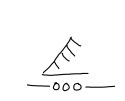
Q&A: What is the “sigil element” in the reading?

inkmagicksigil

Q: I like that you put extras like crystals, aromatherapy, and an affirmation in your handwritten Tarot readings, but what is the “sigil element”? What is that for and what does it do? 

A: I’m sorry I didn’t explain that part more clearly.

When I do in-person readings, I always write notes for the client to have. That lets me draw or doodle any abstract shapes or images that intuition may give during the reading. Most images in a reading are common and easy to describe like ‘rain’ or ‘a tree’ or ‘a teapot’ or what have you. Sometimes I get abstract shapes that hint at a concept and look like schematics or hieroglyphs.  For example, I might get a stair step image to show progress that starts and stops, or a “Y” shape that hints at a fork in the road kind of decision. The sigil element above is an example. It came to mind when I first began developing the “InkMagick” readings a few years ago. It represents a quill pen and paper, while the lines and dots symbolize it being digitized and sent by email. Thanks to new tech that converts my handwriting and doodles right into a .pdf file, now I can share those intuitive shapes in a distance reading the same as in an in-person session or a pen and paper reading.

Around the same time, I discovered sigils and began working with them for my own use. Because I am so new to the art, I don’t claim to be able to create fully formed sigils for clients. I really think sigils are most powerful when you create them for yourself, anyway.

I share the intuitive shapes, psych-a-doodles, sigil elements…whatever you want to call them… for two reasons. First and foremost to better show you what intuition is showing me. Second, I hope the image will inspire the visual, creative side of you.

Which still begs the basic question: What the heck is a sigil anyway?

Sigils are essentially drawn designs that are thought to have some sort of esoteric power or energy, and can act as a talisman or amulet. In other words, it is a shape or symbol that you design in order to attract something into your life or to influence your life experience in some way. The confusing part is the word sigil itself. It can mean old (medieval or earlier) symbols traditionally believed to name and summon demons in ritual magick. The more modern sense of the word still means power symbols, but instead of summoning demons in complicated occult rituals, these contemporary sigils can be used to focus your energy on a particular outcome. It all has to do with your intentions. So like anything intention and energy driven, set your intent clearly in your mind from the very beginning, and stay focused on being a source of light and love throughout the process. Do that, and it is pretty unlikely anything shaggy and goat-headed will show up at your doorstep.

Intention is everything. Intend the loving highest and best. It’s that simple.

That is the theory of it. Now for the nuts and bolts of it.

First decide what you want the sigil to do. Draw it. Activate it. Let it go. It is like a metaphysical Ron Popiel gadget…set it and forget it.

It is up to you how simple or fancy you want to be. You can use a calligraphy brush on fine rice paper, or a ballpoint on a napkin.

You can use some sort of method for creating the sigil, like drawing lines on a grid that corresponds to letters of a key word. You can just draw a collection of smaller meaningful symbols (lines, spirils, crescents, circles and so on) or you can combine letters and shapes.

After you create and draw your sigil, some action is taken to “activate it.” The activation process usually ends with the sigil drifting into your subconscious mind. Tradition holds that it is the subconscious intention that connects with the universe to manifest your intended outcome.

Activation takes all sorts of forms. Some will simply fold up the paper and carry it. The simple act of possessing the symbol in its written form gives it the activation energy. Sometimes sigils are printed on a commonly used object like a shirt or a mug so that when the object is used, the sigil’s intention is energized as well. Some will burn the paper to release the sigil’s energy to the universe to be manifested.

There are many ways of creating and activating sigils. The details are outside the scope of one blog post, so I would suggest reading the experts below for more details if you are interested in sigil making.

In my experience, the real value of a sigil is going through the process of designing it in the first place, however you ultimately use or activate it. It is a creative, expressive process. It converts your desires from verbal to non-verbal form and lets you engage with those desires in an emotional, visceral way that words alone can’t quite capture.

I call the doodles “sigil elements” for lack of a better name. I also hope that they hold more energy for you than simple illustrations. I hope you can use the sigil element to create your own power symbol, or at least think about spirit’s guidance in a way beyond words alone.

Sources:


The Niggles: Hippocrates, Socrates, Cellphones and Hammers.

Benebel Wen recently discussed the ethics of health questions in Tarot readings. Like everything Benebel does, it was brilliantly detailed, meticulous and methodical. (https://youtu.be/EQOwLiTn1Rg) She makes some crucially important points, but on other points, I disagree and it’s been niggling at me. This post isn’t a pedantic point by point response. This is a different conclusion from different point of view. I leave it to you to decide which approach resonates with you.

I may not be the definitive authority on health questions in Tarot, but I do claim expertise. I have been reading Tarot for 25 years, reading professionally for over 15 years, hold a Bachelor of Science in Medical Science, have 14 years of clinical experience as a physician assistant in psychiatry and interventional cardiology plus a Ph.D. in Natural Health. I’ve been a Reiki master-practitioner for almost 20 years. I’ve been on the giving end of bad medical news and, thanks to a rare-ish genetic disorder, I was told that I had almost died from a stroke. I’ve given and received both mainstream and holistic medical care. I know Tarot and I know health care.

And I don’t take medical or pregnancy questions in Tarot sessions.

I didn’t make that choice based on some fancy pants “Tarot Ethics” or boilerplate liability disclaimer. I made that choice based on fundamental medical principle.

And Socrates.

And cellphones.

From the time of Hippocrates and before, healers have first and foremost sought to do no harm. Doing intuitive readings for a health question is not necessarily harmless. A doctor will weigh the risks of a medication, procedure or test versus the benefits of the action. Across the landscape of all of the Tarot readings being done, there is significant risk of harm by means of misinformation, creating false hope or delaying medical diagnosis and treatment. Yes, Tarot has emotional and spiritual benefits. It can even have some broad physical benefit by way of stress reduction. However, those benefits are not sufficient to outweigh the risks. None of us know how a client will react to what we say or what they might selectively hear and retain from a reading. If a client brings up the psychic/spiritual information to a mainstream doctor, it could impact the doctor-patient relationship. It’s a harsh reality. Doctors may take them less seriously or, worst case, write their symptoms off as psychosomatic. I know – I know. It shouldn’t be that way, but it often is. Regional culture may be a factor in the medical community’s openness to complimentary care and “psychics.” Our attempt to “empower” the client could backfire. I don’t take medical questions because the potential unintended consequences out weigh the potential benefits. The best way to do no harm is to do no medical Tarot.

Allopathy (mainstream scientific health care) in America treats the physical without the spiritual. Tarot readings for medical questions address the spiritual without the physical. It isn’t fully holistic. You don’t pound nails with a cell phone and you can’t make a phone call with a hammer. Some things work well together, others don’t. Using Tarot for a healthcare questions is a little like pounding nails with a cellphone. It might work, but it’s not your best option – by a lot. Not when there are so many good hammers out there. Understanding the spiritual genesis of illness can indeed help long term health and healing. “Magic,” “talismans” and “amulets” can indeed engage the mind-body connection and be a useful adjunct to mainstream health care. Still, Tarot/magic/psychic readings pale in comparison to Reiki, aromatherapy, Western herbalism, traditional Chinese medicine, ayervedic medicine and other truly holistic techniques. These disciplines consider mind AND body AND spirit all in one go, and they are arguably effective with or without complimentary allopathic care. Psychic work can not heal the body without complimentary physical care of some sort.

The video made one critically important point. I wholeheartedly agree and can not emphasize enough: Not everyone has physical or financial access to mainstream medical care. There are places in this nation hours away from the nearest obstetrician. My mother has to drive over 90 minutes on back country roads to the nearest MRI machine. Health care access should never be taken lightly or assumed in the name of “Tarot ethics.”

Benebel suggests re-framing the client’s medical question into a form that Tarot can handle and proceed. I would agree but ONLY if you are an experienced intuitive AND take the additional step of re-framing the clients expectations. Benebel mentions this, but I think it warrants more emphasis. To do the right thing for our client, it is necessary to be unambiguously clear that Tarot can not make specific predictions about lab results, end outcomes, etc. Continuing with a Tarot reading after re-framing the question, context and expectations serves some good purposes. It is kind, soothing and addresses the immediate, short-term emotional need. But we can do more. It is possible to borrow a page from mainstream health care with referrals.

If a heart patient needs a big toe bunion fixed, the cardiologist doesn’t do the foot surgery. The heart doctor sends the patient to the foot doctor for specialty care. There is nothing wrong with referring a Tarot client to a health professional who has skills that you do not have. Gathering information to share with clients, such as a phone number for a local free clinic, the health department, local holistic practitioners or even the new 211.org service is one strategy. Steering a client toward resources outside of a reading pays attention to their needs without any of the potential drawbacks.

Socrates is attributed with saying “Know Thyself.” Another reason I will not accept medical or pregnancy questions is that I know myself. We’ve met. Say something medical and boom! Intuition goes out the window and right into clinical mode we go. Not only is Tarot a poor tool for health questions, not every Tarot reader is cut out to deal with medical questions, re-framed or otherwise. In order to give my clients the best of my intuitive work, I choose to defer medical questions. Not everyone can be the second coming of Edgar Cayce. It isn’t a matter of “picking and choosing” the “easy questions.” Unless you have medical training or you are a practicing health-specific intuitive, then it would be better to err on the side of caution and stay away from reading for health questions altogether in my opinion.

You are not a bad or inadequate energy worker if you choose to refuse medical questions. Like Hippocrates, you are choosing to do no harm. You are not being egotistical or flaunting your “ethics” if you refuse medical questions. Knowing your limits and not crossing them is another way of doing no harm. Knowing yourself and the boundaries of your skill is the exact opposite of ego, especially if you go that step further and encourage the client to place their question into more skilled hands. Presuming to read every question, easy or hard, sounds egoistic to me.

As with everything, compassion is the ultimate measure. It seems less important whether you take medical questions or not and more important HOW you decline them if you choose to do so. In all these years, every time I get a medical question, I simply explain to the client the readings I do are not very good at helping health questions and, because of my clinical background, my intuition just doesn’t work well with medical concerns. If I have something else to offer, I will. Usuall y I say something the lines of “you might want to learn more about Reiki” or “so-and-so is in your area and is a wonderful herbalist, but something like that would need to be coordinated with your doctor” or some such thing like that. I’ve never had a client become angry or distressed over that sort of response. Yes, people in physical and emotional distress need our help. Yes, they need us to hold a compassionate healing space for them, but no, we should not always fill that space with a Tarot reading. I agree that we should never dismiss a medical question harshly or judgementally from a place of high and mighty “Tarot ethics.” Tarot clients do come to indeed us out of spiritual and emotional need. But in the case of medical questions, they don’t necessarily need us.