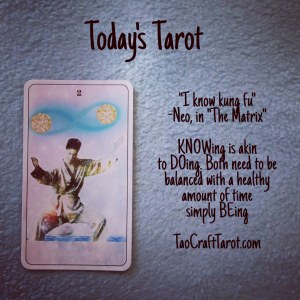
When I saw #Neo from #TheMatrix was #Magician, I knew #heartofstarstarot by Thom Pham was a deck for me. The Matrix ‘s #cookie #baking #Oracle was a big part of the inspiration for my first #Tarot #blog and website, #ModernOracle. I love the part where Neo wakes up and says with a note of awe in his voice “I know kung fu” It always motivates me to practice and reminds me of those rare moments when something your sifu taught finally clicks and for half a second you feel like you might know some tiny molecule of sompin’ sompin’
Knowing means you gotta DO. DOing means in time you’ll know. They are connected, and they are both balanced with a sense of BEing without need of activity, without intellectual judgements.
Heart of Stars Tarot Copyright Thom Pham. Used with permission.
InkMagick Sigil Tarot (both email and paper versions) are still at a special price until the end of April. Each one card meditation style reading includes a sigil element given by intuition that you may use to inspire your own sigil crafting plus a positive affirmation based on your reading.
Please visit the home page to order
customized artistic service, for entertainment and personal enrichment only
We’ll get into the superficial, seeming contradictions between Tarot, spirituality and science some other day. For now, Imma indulge my science loving geek girl side.
In the words of my all time favorite TV show, Mythbusters, “Failure is always an option.”
Only ideas that are confronted can ever change. The best way to challenge an idea is to kick the tires and take them out for a test drive. Also known as an experiment. Tarot, holistic health is based on experimentation and science. Ok, ok I can practically hear your eyes rolling out there. True enough, the 100% accurate predictions, promise to fix your love life, only see me and send money crowd doesn’t pass the smell test, scientific or otherwise. True enough, you can’t objectively measure and double blind control subjective things, but that hasn’t stopped psychology has it? Neither should we intuitive folk be cowed by science snobs. THINK about it. Tarot has been in use for problem solving, personal enrichment, stress management and defacto therapy for hundreds of years. That is a heckuva data set. Everyone and their uncle weighs in on Tarot etc. Those skilled in it write books and practice it, skeptics harpoon it (with and without reason) and charlatans exploit it, but it is clearly doing SOMETHING or people follow the empty promises so easily and they wouldn’t spend their hard earned money on it so consistently. The difference between the good the bad and the ugly falls to ethics. Science celebrates the ethic of honesty as much as we do.
Honesty meaning admitting you have failed. That’s always an option, remember? Not only is it an option, it is something to be celebrated. My favorite part of watching “Meet the Robinsons” with my daughter is when Lewis’ invention fails. Everyone cheers. Everyone is thrilled for him. “From failure you learn. From success, not so much”
So why am I opining about failure? Because I’m pulling the plug on the “Tarot Without a Net” series. It isn’t a failure as a Tarot exercise, but it is kind of a bust as far as being an interesting blog series for you to read. I encourage you to watch Phil Plait’s TED talk below. The first lesson of failure (even tiny ones like this) is admit them to move the larger body of knowledge forward. Admitting failures is an ethical imperative and an important part of science…and Tarot.
I was as happy to see Professor X as I was to see who I thought was ObiWan Kenobi on the Emperor card. It is a perfect bridge between what I see and what the artest saw in these two cards.
It’s been a long year coming, but waaay back when the third edition of Heart of Stars third edition deck was released by Thom Pham, he very graciously gave permission for me to share these posts with you. I am so looking forward to exploring this deck with you because it is very much how I work. If you have ever had a reading with me, there is a good chance that spirit and energy gave a pop culture reference at some point…a song, book, movie or tv show.
It is interesting to me that the very thing I missed by mis-understanding Odin from Thor as Obi-Wan from Star Wars is the exact thing that drives my impression of this card.
The Hierophant (or Pope card in some decks) has always been a nemesis for me personally. The Hierophant / Pope is often associated with social rules and conventions. On the RWS deck it is rife with religious imagery. As an adult child of evangelicals recovered fundamentalist, that is a hot button pushing reflex issue for me. Lucky for me AND my clients, that only happens when I engage with stuff like this, outside of a reading. In a reading, the Hierophant is smooth as silk and clear as a bell because it has to do with connecting with THEIR energies and messages. Please don’t take my wrangling matches with this card to be an indication of what is to come in YOUR reading should this card turn up.
It is much better than it used to be, actually. It took a dozen re-writes to do the “Arcana in Balance” post (I’ll updating and reprising that series here later this year.) Since coming out secular, it has been easier to deal with this card. It is even easier still since Johanne Dinali explaned the card in her twitter feed as the keeper of traditions, like a grandfather or a shaman.
Here, I get the word teacher very strongly from this card. It still has undertones of rules and conventions because the Professor teaches discipline and ethics and how to deal with mutation super powers. It has the same threads of mystery and power. All that Professor X has learned has been long and hard-won….and about mysterious powers. So yes, the Hierophant is the keeper of rules, traditions, social conventions….but to teach them. He teaches mysteries through the same, not just all law and order. It is a subtle, even nonexistant distinction to those who embrace religion, perhaps. To those of us who have experienced and deliberately, mindfully left mainstream religion, it is an important one. The hierophant is more kindly kindly monk-teacher-scribe than lay-down-the-law, missals and diatribes Pope. Professor X and the heart of the Hierophant card is more like teaching us to find and use our X-men powers than it is law-and-order, lock-em-up and throw away the key. The Hierophant is a spiritual teacher – not a religious officer, judge, jury and executioner.
I was browsing for a quote to post with the card as I often do on Instagram (@Taocraft.Tarot) This one by Thich Nhat Hahn caught my eye:
“Doubt in my tradition is something that is very helpful. Because of doubt, you can thirst for more and you will get a higher kind of proof”
That resonates with teaching in a very real world way on multiple levels for me. If we go back to my personal religious issues (obviously not something that will relate to everyone, but shout out to all the ex-vangelicals out there) anything worth learning will stand up to doubt and questioning. Christianity, for me, disappeared in a poof of dust at every question, every doubt. Taoism has stood up through everything life has thrown at me. Tarot has never ending wisdom so far for me AND my clients. That isn’t bragging about my skill…it is bragging about what a reliable, testable, doubt-and-question-tolerant tool Tarot has proven itself to be in my experience.
That is just from the one sided perspective of a student. I’ve taught. This card and this quote has something to say to teachers as well: Questions and doubts are a wonderful thing. When I was teaching Kung Fu and Tai Chi I LOVED it when students had questions. They took the whole class to some really cool wonderful places…to hell with what I had planned. When students question us and doubt us and push us….they are doing US, the teachers and enormous favor. They are showing us the dead spots that need pruned away. They are showing us the empty gaps that need feed. If I don’t know an answer, it is only an embarrassment if I fail to try and find and answer or at least try to point the student in the direction of other possible sources for their answer.
When Professor Hierophant rolls in to a reading, it is a good time to ask questions, face our doubts, test the rules, then follow those guides and lessons that prove trustworthy.
Unsurprisingly, given his choice of Professor X, the artist makes teaching a primary focus, instead of a supporting focus behind the paternal / protector emphasis of the Emperor card.
Deck: Heart of Stars Third edition by Thom Pham, used with permission.
Image copyright Ronda Snow 2019 Used with permission
“What is in a name? That which we call a rose by any other name would smell as sweet”
William Shakespeare, Romeo and Juliet
“What I told you was true, from a certain point of view” – Obi Wan Kenobi
Obi Wan nailed it. Sorry Bill.
Names, labels, adjectives, the power of words; all of those things have niggled at me off and on over the years. The niggling about names hasn’t stopped since we talked about it the other day in the “What is in a Name” post. That was a first step away from Shakespeare’s literalness about flowers. Let’s take it one step more.
Shakespeare was right, of course, in the most literal sense. You could name that particular fragrant flower a “rose” or a “gagglystank” or anything else, and the literal flower would still have the same chemicals causing the same fragrance, the same petals, the same stems, the same thorns and all the same physical attributes.
But, like business and website names, any name has more to it than just literal, physical descriptions. Names, like all of language, is about communication. If I say “rose” and you speak English, you know exactly what I mean. Not just a flower, but a particular type of flower with a particular set of physical attributes. You can probably imagine the scent, the petals, the stems, everything about them. If I say “gagglystank” to you, chances are you will have no idea what it means much less have a physical description come to mind. Gagglystank is a word that tells you a little about my feeling about the scent of roses, but is definitely not the NAME of anything. There is power in a name. Communication happens when things have a name. Communication conquers time and space. That is why “branding”….naming….matters. It is outward communication. A name is immediate, instant communication of what a thing is. TaoCraft Tarot is hint about what I do and my way of doing it.
Shakespeare’s roses (in addition to being a great idea for a band name) is about the literal, unchanging being of objects no matter what words are projected onto them. Names are more than the literal objects. Names are also about every intangible thing the tangible object symbolizes. Outward communication is one step away from the actual things. One more step takes us inward. Consider the psychology and emotional response to a rose.
If we called roses gagglystanks instead, would they really smell as sweet? What emotions and connotations would a different name elicit? I’m not fond of rose scent or anything too cloying or floral. Gagglystank is a perfectly good word to tell you how I feel about the way those specific flowers smell. But it can’t be the name of the thing, because it doesn’t communicate to you. It isn’t a meaning our language has agreed to use. It doesn’t capture the visual beauty. It doesn’t capture the emotional response to the flower generated by generations of love-symbolism our culture has connected to that flower. When we see or hear the name “rose” all at once we understand the literal thing, the things the symbolizes, and likely experience a positive emotional feeling to go along with it all.
First you have a thing. Then you have a name-word for the thing. Then you have all the abstract things that go with the literal thing, all wound up in an emotional response to the whole word-name-symbolism package. Names means a lot.
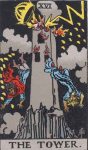
This second-step away from Shakespeare’s roses is the place where Tarot cards get their power. The cards have powerful images. The cards use powerful words. They prompt us to take that next step beyond literal things and outward communication in order to get right to the realm of symbolism, emotional connotations and, most importantly, inner response. The Tower comes to mind. Set aside the lighting and other images, lets talk about just the Tower alone for a minute. First you have a literal picture of a literal tall thing. You name it Tower, and without the picture, a Tarot reader can convey instant understanding of both the thing and the image. If I say “tower” then you know I’m talking about a big tall skinny outdoor object or part of a building. Then you bring in all the connotations of a tower: tallness, a higher perspective, potential isolation. The inner FEELING of the reader guides the seeker to the right connotation and symbolism, even when reader and seeker are the same person. The process of inward symbolic communication…the second step away from Shakespeare’s roses…is where a Tarot reading really happens. This kind of word and name driven inward communication is the same no matter if you are reading for yourself or someone else, nearby or at a distance.
The thing, the name of the thing, along with the symbolism, connotations, and emotions that the name carries are all part of intuitive communication. Names speak both outwardly and inwardly.
There is power attached to a name. That power can attach to any name for any thing in any language, but not every name carries that level of potency. Roses by other names may not smell as sweet except in the literal sense. Roses by their true name have a complex fragrance…from a certain point of view.



You must be logged in to post a comment.