Sit down!

Another way to understand reversed (upside down) cards in a Tarot reading.

I don’t know who enjoyed the cartoons more, my daughter or me.

Kids in the early 2000s had way better shows to watch than we did. But then, I’m old and decrepit and had to wait for Saturday to watch them. Still, Spongebob and Jimmy Neutron rocked.

One of the funnier bits in Jimmy Neutron was when Jimmy and Cindy used double negatives to get the teacher to give them permission to leave the classroom. When Carl tried to use some sort of complicated quadruple negative, all he got from Mrs. Fowl was a loud “Sit Down, Carl!”

Sometimes reversed Tarot cards are like Carl’s double negative attempt and they need to sit down.

Energy flows like a river. Tarot can point out where the current flows most freely…and where there are rocks in the way. Sometimes there are whirlpools and eddies and quiet pools. Reversed cards can make things go in circles if you get too tied up in them. There is a general notion that if a card turns over upside down (relative to the person doing the reading) its meaning is also reversed, presumably flipping the card from positive to negative connotations. Sometimes a reversed card is generally felt to be a negative omen, regardless of the specific card or meaning.

If the card points to the dark side of life in the first place?

If the reversed bad card is turned into a good card, why not just throw down a good card in the first place? Isn’t there more to it than that? Doesn’t that rob the reversal of any meaning? So what if it does?

Reversed cards can be difficult for beginner readers, exactly because of these swirls of energy (and questions) and the double negative style of communication. This is why I tend to tell reversed cards to sit down.

Double negative communication and any difficulty with reversed cards begins from a place of absolutes. The root mistake is to think a card has a fixed positive or negative connotation in the first place.

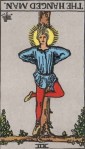
My method for dealing with reversed card is to view it as neutral regardless of orientation on the table. Take today’s card, the Hanged Man as an example. Let’s give it the ‘stagnation’ meaning today. For someone who has been harried and hurried and pushed, a time of being “stuck” might be a gift of enforced rest just when it is most needed. For someone who is rested and ready to move, “stuck” is a source of enormous frustration. To the first person, if the hanged man is read as meaning lots of new starts and forward momentum, which indeed could be negative and stressful for someone already too much on the move. For the second person, reversed hanged man and the connotation of forward movement is good news, not one bit negative in any way. The card and its message is neutral, not matter how it falls on the table or which side of its nature steps forward. The good or bad, positive or negative is assigned in context by the sitter (Sitter or seeker means the person getting the reading. When you read for yourself, reader and sitter are the same person.)

By beginning from a position of neutrality about the base card meaning, allowing the client to make any ‘positive’ or ‘negative’ judgement about how the card’s message applies to them. It makes it easier to read a reversal: take whatever meaning steps forward to you. If it is reversed, that simply means that the idea, life lesson or energy movement is blocked or challenged in some way, like a whirlpool outside of the river’s primary flow.

Or, it may mean nothing other than random chance in a deck that has been used and shuffled.

Let your intuition be your guide. If no intuition steps forward, then default to method. In this case, make the base card neutral in good vs bad, consider all the possible meanings for the card, and take the reversal to mean slowed or challenged energy surrounding whatever the card is addressing.

Class dismissed. You can stop sitting down now, Carl.
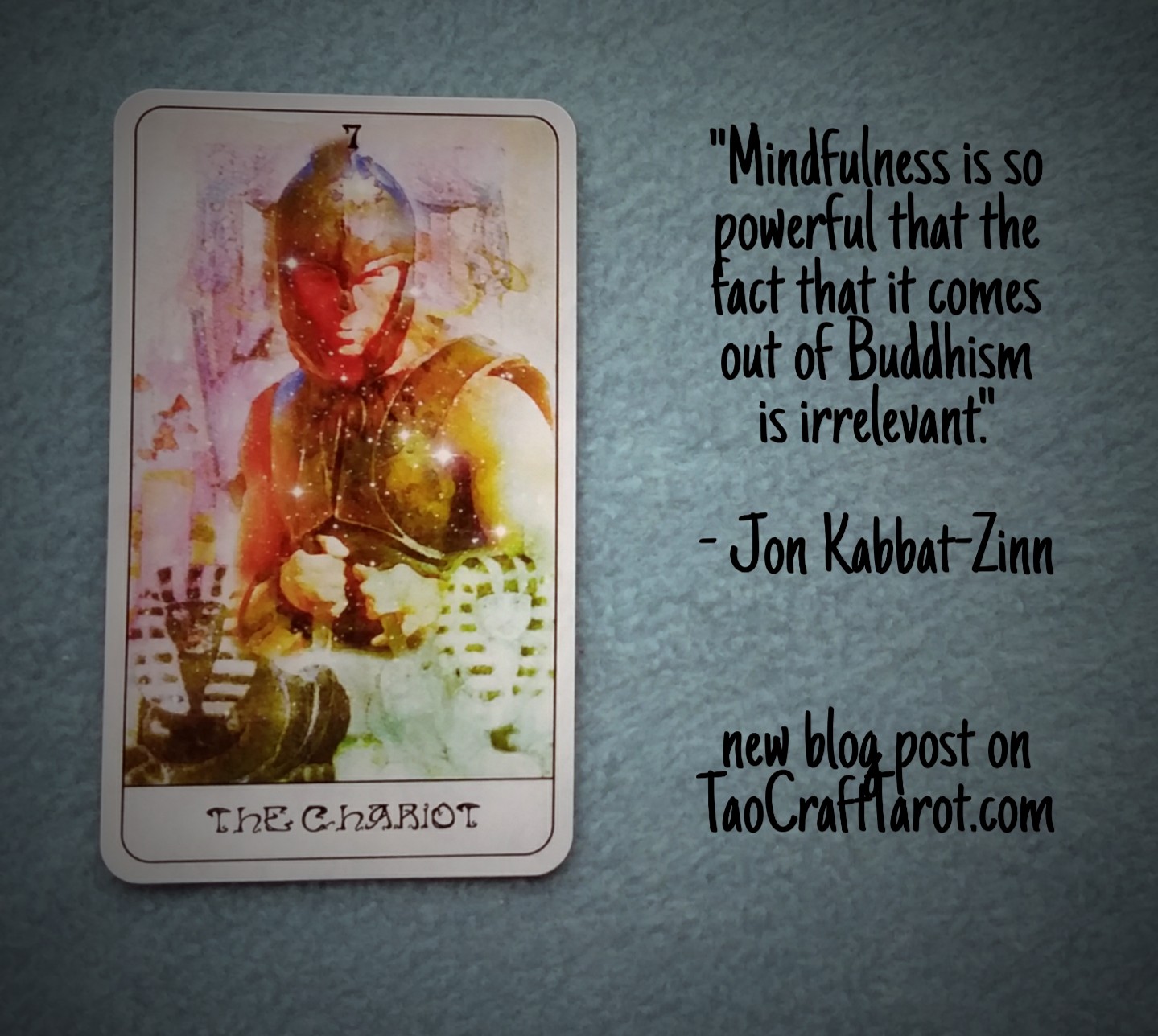
Tarot Without a Net: The Chariot

I feel a movie mistake coming on, but I can make up for it with a double pop culture reference.

I’m guessing this is Ben Hur, with what I’ve heard is the most epic chariot scene ever filmed. Again, I haven’t seen it, except the chariot clip on award shows and such.

At first glance, it gives all the classic impressions associated with The Chariot: the need to focus, to be in the moment, give your full attention to something.

The gladiator image really catches my attention though. It expands my thinking about the card, actually. I see the gladiator presentation in terms of a warrior. As a martial artist (a little Kung Fu back in the day, now it is very casual, occasional Taijiquan and Qi gong) I’ve always kind of wondered which Tarot card would be the best “warrior” card. I don’t think you can narrow it down to one card, really. The whole concept is complex, and takes several cards to touch on all the philosophical facets of “warrior” especially in the honor/busidho sense of things. This comes very close, however.

Martial artists and warriors often meditate. According to curiosity.com Navy Seals do breathing patterns akin to yogic and meditation practices to enhance calm.

Calm, focused, in the moment, paying full attention to the task at hand…all traits that warriors and chariot drivers share (chariots were, after all, used in battle too)

Now for the artist’s guide…I’m curious to see if it really is Ben Hur.;;;\

LOL nope….Achellies in the movie Troy. Ah well. Haven’t seen that one either. But that is fine by me….I still like the artwork, color, composition of the cards even if I don’t get the exact movie reference

WHICH, by the way, is an excellent insight into how Tarot works overall. Spirit/energy/intuition might not give us the EXACT information of the message, the reading might not predict your true love’s hair color…but the essence of the message always somehow makes it through.

Oops…oh well. Puts me in the mood for that other pop culture reference. I liked the cartoon “Jimmy Neutron” as much or more than my daughter did. In one episode, Jimmy and Hugh go camping leaving Mrs. Neutron alone for the weekend. Her response? Gather up the dog and break out the cookie dough and gladiator movies. That sounds pretty in the moment…as in ENJOYING the moment….to me.

Wishing you a wonderful moment right here, right now.

Eternal Balancing Act

2coins

Diane Morgan’s Magical Tarot, Mystical Tao is for all the obvious reasons, one of my all time favorite Tarot books.

I first read Magical Tarot, Mystical Tao early in the 2000s, at the beginning in my professional Tarot career, just as I began reading for online services like Advice Trader and Allexperts. I’d been reading Tarot and oracle cards (Medicine Cards by Carson and Samms mostly) for nearly 10 years by that point. I’d been interested in Taijiquan (Tai Chi) and Taoism even longer than that.

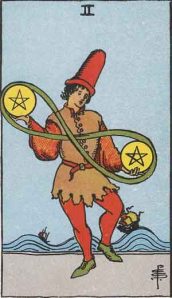
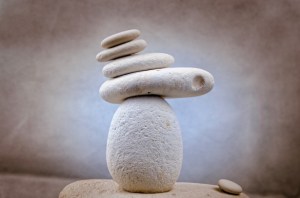
Of all the cards in the Tarot deck, the two of Pentacles / Coins is arguably the most emblematic of all that Tarot and Taoism share. We short hand the card as balance, but it is more of a juggling act than that. The balance here is large and moving and dynamic. Balance alone can be static, like a stack of zen stones, or a scales showing accurate weight.

balancing-stones

That is balance, but there is also what science calls dynamic equilibrium.  The classic example of dynamic equilibrium is a permeable membrane between two solutions. Think of fresh water and salt water divided by some sort of plastic wrap with tiny holes in it. The molecules on both sides are always vibrating and wiggling around (that is heat, so let’s imagine this is all happening at room temperature, not absolute zero.  Even a polar vortex isn’t that cold.) Over time the water and salt molecules wiggle through the holes in the membrane until there is the same concentration of salt and water on both sides. Once that happens, the molecules don’t stop jiggling and juggling around. It is still room temperature, there is still heat and molecule movement going on. If you follow individual specks of salt, they may be moving the whole time, one side to the other. Same for specks of water. In spite of the little specks dancing around, the total amounts of each stay in balance on both sides. The little buggers move…it’s dynamic. The whole system, the whole tank of water, keeps its balance of salt and water concentrations…it is in equilibrium. That kind of balance is very much a part of the 2 of coins. The artwork in the card on most RWS decks hint at movement, the man walking and juggling , a woman bicycling (Steampunk Tarot) a tightrope walker (Robin Wood Tarot) even someone standing on their head (Quantum Tarot) The two of coins reminds us as much of dynamic equilibrium as a static balance. The sideways figure 8, the infinity symbol, is often used as part of the cards image to indicate that balance. It also shows us just how big the water tank is. The system that is in dynamic equilibrium is nothing less than the whole darn universe. Sure things are going to get very out of balance, if not downright wonky in our individual part of the cosmos, but infinity wide, things unfold as they should, according to their nature.

Which is all a very Taoist like way of looking at it. The Taoist point of view values that kind of big picture dynamic equilibrium. It values balance in general…static and moving…and is more than willing to consider the Tao, the everything and then some, in finding that natural moving balance. Harmony of opposites is another, easier way to put it. The well known yin yang symbol that is emblematic  of the philosophy is actually intended to be in motion. The dots are the seeds that grow into their opposite. If you look just at the yin or yang, the black or white, each part is always growing, shrinking, turning. Yet, within the circle as a whole, even among all that movement, there ends up being balanced, equal amounts of black and white, yin and yang.

3daniyinyang

That is the energy flow the two of coins can help us to find. The two is always about balance. Is it static or dynamic? What kind of balance do we need? Are we looking at one little jiggly speck of salt in the water and feeling out of balance? Would it help to look for larger, moving systems when we look for balance in out lives or would it help to look for the little but very stable balance points like stacking Zen rocks? How do you know? The balance is of opposites, remember? The dots are the clue. In each lies the seed of its opposite. If you have been focusing on static stable balance, but it isn’t working, take a step back and look at the big picture, moving systemic balance. If the system seems chaos and everything is flying apart…look for anchors. Look for the solid, stable, static parts on which to build some balance.

Stones and yin yang images from the public domain. Jimmy Neutron property of Nickelodeon via youtube.com.