InkMagick Sigil Tarot (both email and paper versions) are still at a special price until the end of April. Each one card meditation style reading includes a sigil element given by intuition that you may use to inspire your own sigil crafting plus a positive affirmation based on your reading.
Please visit the home page to order
customized artistic service, for entertainment and personal enrichment only
I feel a movie mistake coming on, but I can make up for it with a double pop culture reference.
I’m guessing this is Ben Hur, with what I’ve heard is the most epic chariot scene ever filmed. Again, I haven’t seen it, except the chariot clip on award shows and such.
At first glance, it gives all the classic impressions associated with The Chariot: the need to focus, to be in the moment, give your full attention to something.
The gladiator image really catches my attention though. It expands my thinking about the card, actually. I see the gladiator presentation in terms of a warrior. As a martial artist (a little Kung Fu back in the day, now it is very casual, occasional Taijiquan and Qi gong) I’ve always kind of wondered which Tarot card would be the best “warrior” card. I don’t think you can narrow it down to one card, really. The whole concept is complex, and takes several cards to touch on all the philosophical facets of “warrior” especially in the honor/busidho sense of things. This comes very close, however.
Martial artists and warriors often meditate. According to curiosity.com Navy Seals do breathing patterns akin to yogic and meditation practices to enhance calm.
Calm, focused, in the moment, paying full attention to the task at hand…all traits that warriors and chariot drivers share (chariots were, after all, used in battle too)
Now for the artist’s guide…I’m curious to see if it really is Ben Hur.;;;\
LOL nope….Achellies in the movie Troy. Ah well. Haven’t seen that one either. But that is fine by me….I still like the artwork, color, composition of the cards even if I don’t get the exact movie reference
WHICH, by the way, is an excellent insight into how Tarot works overall. Spirit/energy/intuition might not give us the EXACT information of the message, the reading might not predict your true love’s hair color…but the essence of the message always somehow makes it through.
Oops…oh well. Puts me in the mood for that other pop culture reference. I liked the cartoon “Jimmy Neutron” as much or more than my daughter did. In one episode, Jimmy and Hugh go camping leaving Mrs. Neutron alone for the weekend. Her response? Gather up the dog and break out the cookie dough and gladiator movies. That sounds pretty in the moment…as in ENJOYING the moment….to me.
Wishing you a wonderful moment right here, right now.
I’ve never seen “Titanic” and precisely zero interest in ever watching it. I don’t care for romance movies, and from everything I’ve heard the movie has a disturbing lack of comedy and/or spaceships.
I have no idea why the artist picked this image to represent heart’s desire, or even lusty romance. I’m not feeling a lot of connection with the deck through this card, probably from my impression of the movie it represents way more than the card or the artwork itself.
The Lover’s is an interesting and often misunderstood card, thanks to the movie mythos that the lovers card means a hot romance is on the way with the marriage of a lifetime soon to follow. In my experience, the card is far more abstract than that. It is more akin to “I love ice cream” than the handfasting, marriage, committed, soulmate, love of a lifetime energy that we see in the Two of Cups. The Lovers symbolizes the hot flame that burns short rather than the enduring ember that burns long. Don’t get me wrong, there is some connection, because many if not all long lasting relationships start with SOME sort of spark. Maybe that is why the artist chose this love story from a movie. Maybe the movie portrays a hot romance that gets cut short by a quick dunk in the north Atlantic. Still, it niggles at me that it is wrapped up in a romantic relationship. The Lovers card can be more than that….which is saying something considering how enormous romance is within the human heart. And that’s with leaving the hormones out of it. Like everything there is a two sided yin and yang of it. (See “Arcana in Balance: The Lovers from the Tarotbytes archives).
It isn’t to say that lust, sex, love, desire and full throttle joy of living is bad. Quite the opposite. On one hand, all of those things are part of normal human existence and is as worthy of acceptance as any other emotion. That physicality and abject hedonism is certainly one part of it, but it also transcends the physical. On the other hand, the desire Lover’s card can extend far beyond the realm of romantic relationship. It touches our careers….do we earn our living doing something we are passionate about? In that way The Lovers card asks us to consider our purpose in life, our raison d’etre, our calling if you will. Emotionally it touches on satisfaction, contentment, and emotional needs being met. Intellectually, it touches curiosity, enthusiasm, and voracious learning. Arguably, passion resides in the mind as much as the heart or the hormones. You can be a passionate bowler, or stamp collector as well as being capable of passionate romance. You can be passionate about anything. Love is a big concept that encompasses all sorts of things.
So lets pick up the book and see what the artist has to say:
Whew! Even though we differ in movie taste, the basic interpretation is similar. He also talks about emotions, the joy of living and loving what you do. The connection to the card is similar (it is a fun to get that kind of validation every now and again, even if you have been reading Tarot a long time) even if my connection to the movie represented is obviously quite different. That is the danger of using pop culture references in Tarot. Not everyone has seen every reference or interprets the reference material the same way, even if the intuitive engagement with the Tarot card itself is identical.
When a pop culture reference comes up in a reading (regardless of the deck I’m using) but the client either doesn’t know the reference or responds to it differently than the message and card intend…the thing to do is drop the reference like a hot potato. When that happens you either have to find a different cultural reference that does communicate the intended message OR leave references aside and use your good old fashioned vocabulary. Adjectives are our friends. References like these can be wonderful communication tools, but they aren’t worth holding onto so tight that the reading suffers.
New Stuff on the Way!
TaoCraft Tarot is still evolving to serve you better. You can order email readings right from the home page with SECURE PayPal buttons. Mala and Reiki orders coming soon. Come back often to check out all the updates, tweets and changes that will make TaoCraft your one stop shop for Tarot, distance Reiki, tutorials, and more.
I am really enjoying getting to know the Heart of Stars Tarot deck by Thom Pham (used in the blog series with his permission). The idea of using modern movie and TV icons on the deck as he does is SO in my wheelhouse. Pop culture is a conceptual Rosetta Stone, a perfect analogy for communicating the more esoteric or arcane parts of Tarot.
I was totally fangirling over seeing a Star Wars image. I’ve been a Star Wars fan from the word go when Episode IV first hit the world back in ’77. Given that there is an actual Emperor in the movie it took a little squinting and staring to wrap my head around seeing Obi Wan on the Emperor card. The villain Emperor certainly wouldn’t work for the card, but at first blush I would have pegged Obi Wan more of a Hermit type, since we first meet him at his isolated home in the Tatooine desert. Fast forward to the scenes in the Millennium Falcon where Obi Wan is teaching Luke to use the force in light saber training, and the conversations he had with Luke as a Force ghost in later movies.
Every Jedi is an emperor. Every one of us is an emperor.
It isn’t explicit by any means, but think of Qwi Gon and the earlier Jedi in the prequals. Think of the independence, self-direction and responsibility. The Jedi counsel were harsh taskmasters in some respects. They had to hold each and every Jedi to account. Each and every Jedi was ultimately responsible for their actions. Each and every Jedi was the emperor of their own being and their own destiny and their own actions.
And so are we. We may not be able to control our external circumstances at all. Internal emotions are normal, natural, and are not meant to be stifled, suppressed or in themselves controlled. We DO have 100% control AND 100% responsibility for how we react to those external circumstances and internal emotions. What we do and chose in response to those things determine our destiny. We are the absolute Emperors over our internal world even as we work to be in harmony with external energies and our internal emotional pulls. We are the rulers and protectors of our actions, even if we strive to serve as the Jedi do.
Let’s see what the artist has to say about Obi Wan…
He says it’s Anthony Hopkins as Odin in the movie Thor.
Ah well, that makes sense in the leader / ruler context WAY more than Obi Wan Kenobi. I totally missed that. Funny, since I’ve seen Thor and am a big fan of Marvel Universe movies (sorry DC folks)
But I get the vibe. He adds a mentoring, paternal element, as Odin was Thor’s father. I guess Obi Wan is close, a surrogate father with a connection to Luke’s actual father. Either way….older male father figure lends stability, & teaches us to be responsible leaders
4 of Swords…comtemplating….deciding…IS doing something. The mind needs space to work. That workspace at times takes the form of rest, inactivity, watching what thoughts come and letting them go…you know…meditation.
Diane Morgan’s Magical Tarot, Mystical Tao is for all the obvious reasons, one of my all time favorite Tarot books.
I first read Magical Tarot, Mystical Tao early in the 2000s, at the beginning in my professional Tarot career, just as I began reading for online services like Advice Trader and Allexperts. I’d been reading Tarot and oracle cards (Medicine Cards by Carson and Samms mostly) for nearly 10 years by that point. I’d been interested in Taijiquan (Tai Chi) and Taoism even longer than that.
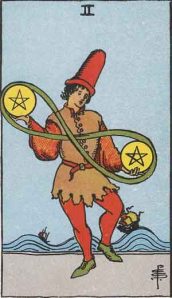
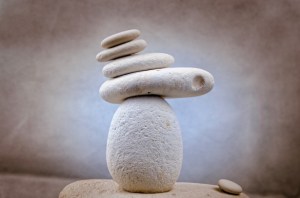
Of all the cards in the Tarot deck, the two of Pentacles / Coins is arguably the most emblematic of all that Tarot and Taoism share. We short hand the card as balance, but it is more of a juggling act than that. The balance here is large and moving and dynamic. Balance alone can be static, like a stack of zen stones, or a scales showing accurate weight.
That is balance, but there is also what science calls dynamic equilibrium. The classic example of dynamic equilibrium is a permeable membrane between two solutions. Think of fresh water and salt water divided by some sort of plastic wrap with tiny holes in it. The molecules on both sides are always vibrating and wiggling around (that is heat, so let’s imagine this is all happening at room temperature, not absolute zero. Even a polar vortex isn’t that cold.) Over time the water and salt molecules wiggle through the holes in the membrane until there is the same concentration of salt and water on both sides. Once that happens, the molecules don’t stop jiggling and juggling around. It is still room temperature, there is still heat and molecule movement going on. If you follow individual specks of salt, they may be moving the whole time, one side to the other. Same for specks of water. In spite of the little specks dancing around, the total amounts of each stay in balance on both sides. The little buggers move…it’s dynamic. The whole system, the whole tank of water, keeps its balance of salt and water concentrations…it is in equilibrium. That kind of balance is very much a part of the 2 of coins. The artwork in the card on most RWS decks hint at movement, the man walking and juggling , a woman bicycling (Steampunk Tarot) a tightrope walker (Robin Wood Tarot) even someone standing on their head (Quantum Tarot) The two of coins reminds us as much of dynamic equilibrium as a static balance. The sideways figure 8, the infinity symbol, is often used as part of the cards image to indicate that balance. It also shows us just how big the water tank is. The system that is in dynamic equilibrium is nothing less than the whole darn universe. Sure things are going to get very out of balance, if not downright wonky in our individual part of the cosmos, but infinity wide, things unfold as they should, according to their nature.
Which is all a very Taoist like way of looking at it. The Taoist point of view values that kind of big picture dynamic equilibrium. It values balance in general…static and moving…and is more than willing to consider the Tao, the everything and then some, in finding that natural moving balance. Harmony of opposites is another, easier way to put it. The well known yin yang symbol that is emblematic of the philosophy is actually intended to be in motion. The dots are the seeds that grow into their opposite. If you look just at the yin or yang, the black or white, each part is always growing, shrinking, turning. Yet, within the circle as a whole, even among all that movement, there ends up being balanced, equal amounts of black and white, yin and yang.
That is the energy flow the two of coins can help us to find. The two is always about balance. Is it static or dynamic? What kind of balance do we need? Are we looking at one little jiggly speck of salt in the water and feeling out of balance? Would it help to look for larger, moving systems when we look for balance in out lives or would it help to look for the little but very stable balance points like stacking Zen rocks? How do you know? The balance is of opposites, remember? The dots are the clue. In each lies the seed of its opposite. If you have been focusing on static stable balance, but it isn’t working, take a step back and look at the big picture, moving systemic balance. If the system seems chaos and everything is flying apart…look for anchors. Look for the solid, stable, static parts on which to build some balance.
Stones and yin yang images from the public domain. Jimmy Neutron property of Nickelodeon via youtube.com.
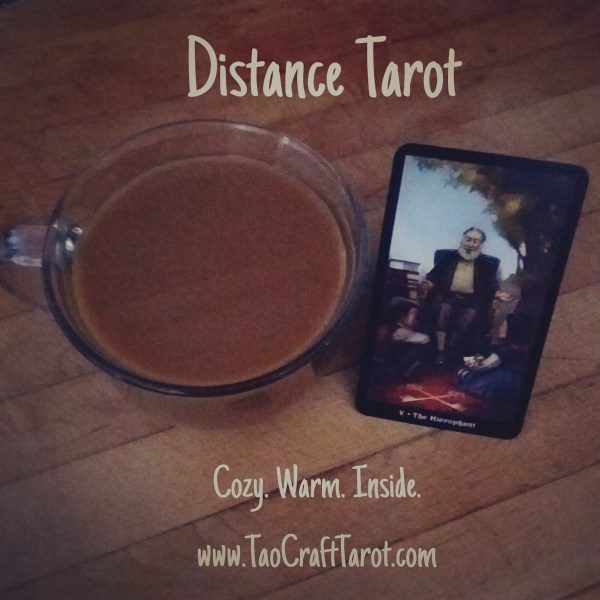
Tarot readers are people too, and have our emotional triggers. Some cards push our buttons more than others. Giving a reading touches our hearts and minds as much as getting a reading. The Hierophant card is a challenge for me when it is drawn in full pointy hat christian-heavy regalia. Just not my wavelength. Fairly or not, my life experience and point of view made the RWS Pope look wrapped in rules and judgement. Until – thank you social media – I read a framework for the card that made sense out of it. At the same time I found decks with artwork that fit the new conceptual fit. In short order, the dogmatic, pedantic pope-ish character morphed into a Grandpa.
Think stories by a campfire. Think shamen. Think wise elder. Think teacher. Think Yoda.
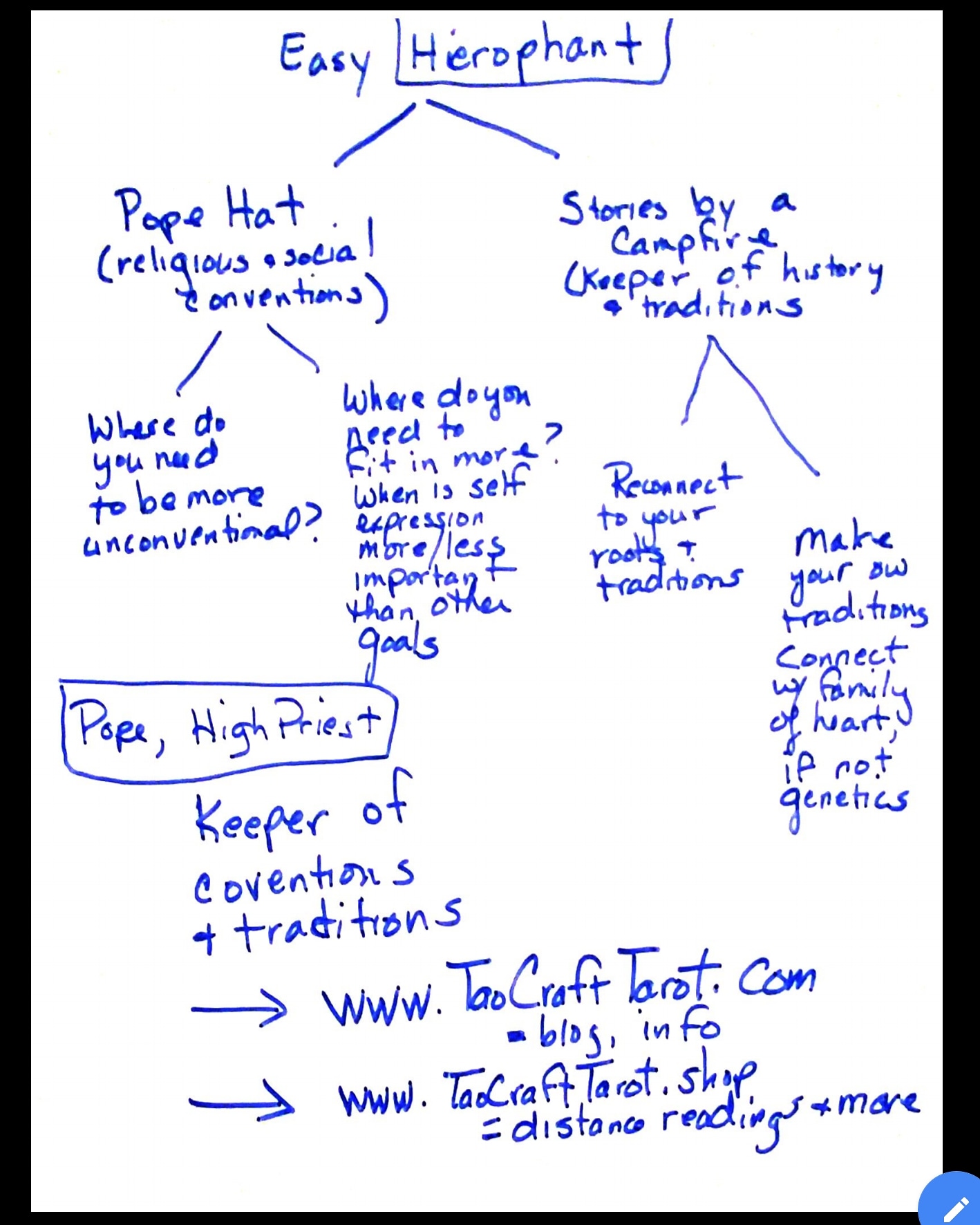
Whichever deck we use, when the Hierophant comes into a reading for a client, intuitively, it seems to take one of those two tracks, whichever best suits the client’s needs I assume. It either vibes with rules or traditions.
On one hand, it seems to have to do with social conformity, playing by the rules. It is compliance with a Papal Edict. Or, it could have to do with nonconformity, breaking social convention, rejecting other people’s expectations. It seems like the sense of it doesn’t follow whether the card is reversed or not. It seems more triggered by the clients nature. If the client is a natural conformist, then it seems to nudge toward being their own person, pushes them a bit toward freer thinking. If, on the other hand, the client is naturally a freethinker, or a rule-bender, then it may be a nudge to “play by the rules” a little more in some respect.
Now that the ‘keeper and teacher of traditions’ notion has crossed my path, it comes through at times even if I happen to be using the RWS deck. It seems to come through with that energy at times when the client is feeling a little uprooted, or disconnected, emotionally or spiritually orphaned somehow. When this is the energy, the Hierophant is a call to join the circle, learn of the past, learn of roots and connections. Just as we are each our own best minister or pope, we are at times our own hierophant, finding and adopting our own spiritual tradition on a path apart from our past or upbringing. Either way, it is about learning a new pattern.
It is a pattern of twos, of balance, in understanding the Hierophant. Comply with rules or find your own path. Embrace or rediscover your tribe and deep traditions or celebrate your initiation into a tribe of one. Either way, the Hierophant is teaching us our path and spiritual tradition.



 Sage Sips / TaoCraft Tarot
You must be logged in to post a comment.