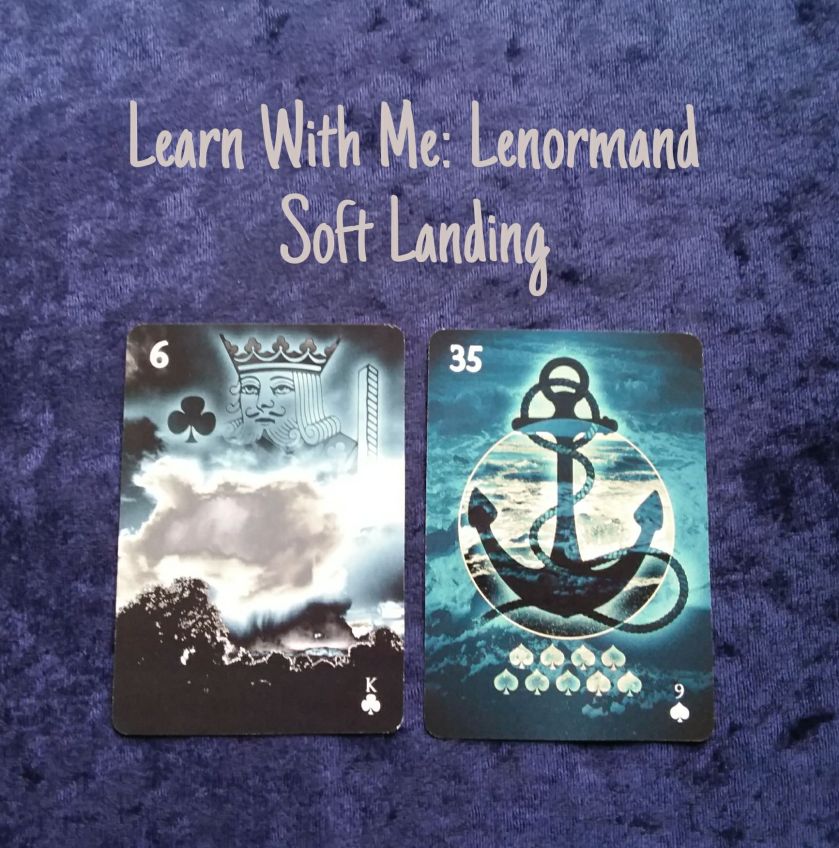
It’s the end of the month, and tomorrow I hope to start a new series with a different spin on “My Tarot Valentine” – a look at the fourteen cards of the suit of wands with an eye to your relationship with yourself, a key step on the path toward finding a good long term relationship. That being said, this feels like the right time and the right cards to bring the Lenormand series of Learn With Me posts in for a soft landing.
Lenormand and RWS has both key differences and key similarities. Lenormand is much more reliant on the layout and the connection between the cards than RWS style. One card readings aren’t as useful because the connection to other cards is so essential to the overall understanding. With the smaller deck, Lenormand does seem to be more forthright, and less nuanced. Lenormand relies on pure intuition, or so it seems to me, with regard to reversals, use of the playing card insets, and so on. The grand tablau layout is rediculously muddled, chaotic and unhelpful to my eye, while a two card reading is incisive and clarifying.
They typical decks, from what I’ve seen, have a muted vintage color palatte. The Healing Light deck by Christopher Butler used here is a stand-out with its rich colors and artwork. Of all the Lenormand decks I’ve seen, this is far and away my favorite.
Today we have Clouds and The Anchor.
Clouds to Mr. Butler’s reading symbolizes confusion, foggy vision, lack of clarity. If it to the left of other cards, as it is here, then the difficulty is read as temporary.
The Anchor is steady, routine, something intractable. Especially when paired with the Coffin card, it can reference a bad habit or something else that needs changed but is very resistant and difficult to change.
Today the core of the reading occupies a place between the two of pentacles and the Temperance card. Rather than clouded vision, fogginess or confusion, the thing that grabs my attention with the cloud card is change.
It is in the left side position that the guidebook suggests is most likely to change. Clouds change often and easily. “Mercurial” and “capricious” comes to mind. Anchors are the opposite. They resist change. They are employed to stop change. Avoiding all change is as effective as tying an anchor to a cloud. If these cards resonate with you, what do you need to anchor and what do you need to let drift away naturally
It’s time to end the series. It’s time for a soft landing. It’s time to anchor the important things and let this topic drift away – at least for now.
What would you like to learn next?
See you at the next sip!

 Sage Sips / TaoCraft Tarot
You must be logged in to post a comment.